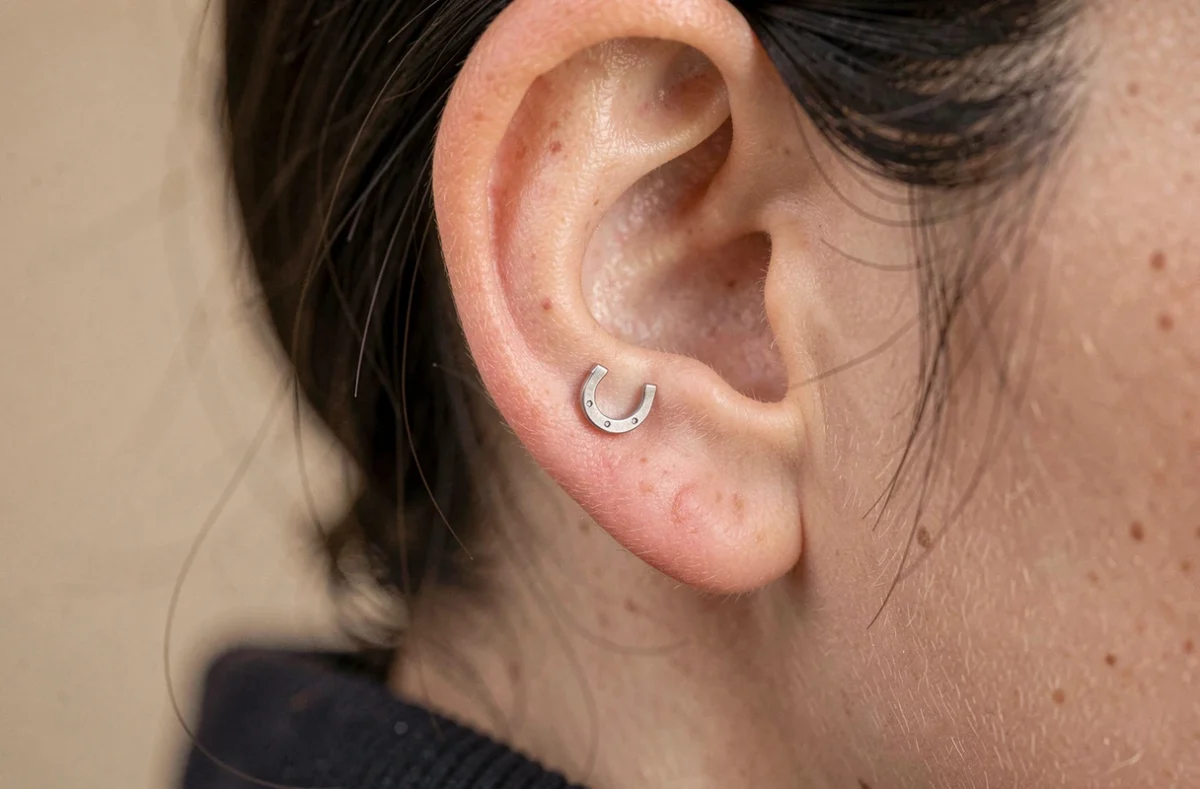
The horseshoe, also known as a circular barbell, is an open arc-shaped piece of jewelry finished with two screw-on balls. Worn in the tragus—the small cartilage flap at the entrance to the ear canal—it creates a different look from a classic labret or closed hoop. Its distinctive shape comes with specific size, material, and weight considerations to keep in mind before buying.
Tragus anatomy and horseshoe jewelry considerations
The tragus is a cartilage projection whose thickness and width vary from person to person. A poorly sized piece of jewelry can press against the ear canal or protrude too far from the ear, causing friction with in-ear headphones or a phone.
Unlike a flat-back labret, a horseshoe is more mobile: its curved bar does not sit flush against the skin. This residual movement can slow healing in a fresh piercing. The Association of Professional Piercers (APP) recommends choosing initial jewelry suited to your anatomy and stage of healing, since a moving hoop can irritate the piercing channel during the first few months.
A tragus cartilage piercing can take six to twelve months to heal completely, according to the Cleveland Clinic. Being pain-free does not mean the tissue has fully stabilized. Switching to a horseshoe for the tragus too soon can lead to complications such as hypertrophic scar tissue.
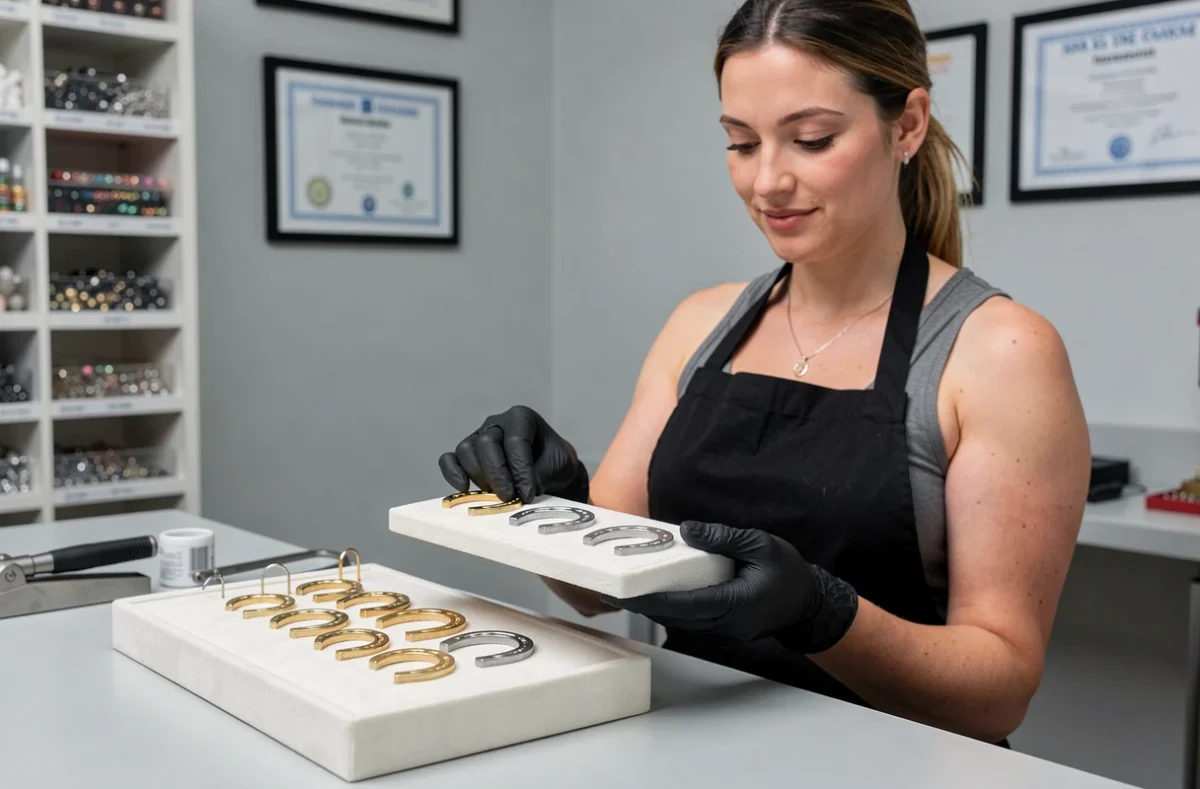
Horseshoe size and diameter for the tragus
Two measurements define a horseshoe: the bar thickness (gauge) and the inner diameter of the arc (the distance between the two ends, measured along the inside of the curve).
Bar thickness
The standard size for a tragus piercing is a 1.2 mm bar diameter (16G gauge). This is the most common thickness for ear cartilage piercings. A thinner bar (1 mm) may migrate under tension, while a thicker bar (1.6 mm) is generally better suited to septum or nipple piercings.
Inner diameter of the arc
For the tragus, an inner diameter that is too large makes the jewelry protrude from the ear and catch on hair or headphones. A diameter that is too small compresses the cartilage and restricts local blood flow.
- A small-diameter arc sits close to the tragus, reducing snags but leaving little room if the cartilage swells.
- A medium-diameter arc offers a balance between appearance and everyday comfort, especially for people who regularly wear in-ear headphones.
- A large arc creates a more noticeable look, but is better suited to the helix or daith than the tragus, where space is limited.
The only reliable way to determine the right size is to have a professional piercer measure it. They can assess the cartilage thickness and tragus depth with calipers.
Horseshoe materials: titanium, gold, and EU nickel regulations
Choosing a material is about more than appearance. For cartilage piercings, skin tolerance and jewelry weight directly affect comfort and healing.
ASTM F136 titanium
Implant-grade titanium (ASTM F136) is the material most recommended by the APP for piercing jewelry. It is lightweight, corrosion-resistant, and releases very little nickel. A verifiable standard (ASTM or ISO) is more reliable than a generic “hypoallergenic” label, which has no precise regulatory definition.
Solid gold
14- or 18-karat gold is suitable for healed piercings. Because it is heavier than titanium, it is less suitable for a tragus that is still healing. It is also important to check that the alloy does not contain a high level of nickel, especially for jewelry imported from outside the European Union.
European nickel regulations
In Europe, the REACH Regulation limits the release of nickel from jewelry inserted into the body. The rule applies to the rate of nickel release, not to its complete absence from the alloy. A 316L surgical steel horseshoe contains nickel but may still meet the European release limit. For reactive skin, ASTM F136 titanium remains the safest choice.

Ball size and everyday comfort in the tragus
The two screw-on balls at the ends of a horseshoe determine how much space the jewelry takes up. Smaller balls fit more easily under headphones or a headset. Larger balls, sometimes set with stones such as zircon or opal, add dimension but increase the risk of snagging.
- Smooth, round balls make daily piercing care easier and reduce residue buildup.
- Cone-shaped ends (spikes) create a bolder look, but their edges can irritate the surrounding skin if the jewelry moves.
- Flat or discreet ends are an option for people who wear in-ear headphones for several hours a day.
Check the ball closures regularly. An end that comes loose unnoticed can leave you searching for your jewelry in a pillow—or in the ear canal. Checking the tightness once a week with clean fingers is enough to prevent this problem.
A horseshoe for the tragus is best treated as a second-stage piece of jewelry, ideal once a piercer has confirmed that the piercing is healed. The right inner diameter, bar thickness, and material depend on your individual anatomy, not on a universal size. Have your tragus measured before buying to avoid most comfort and healing problems.