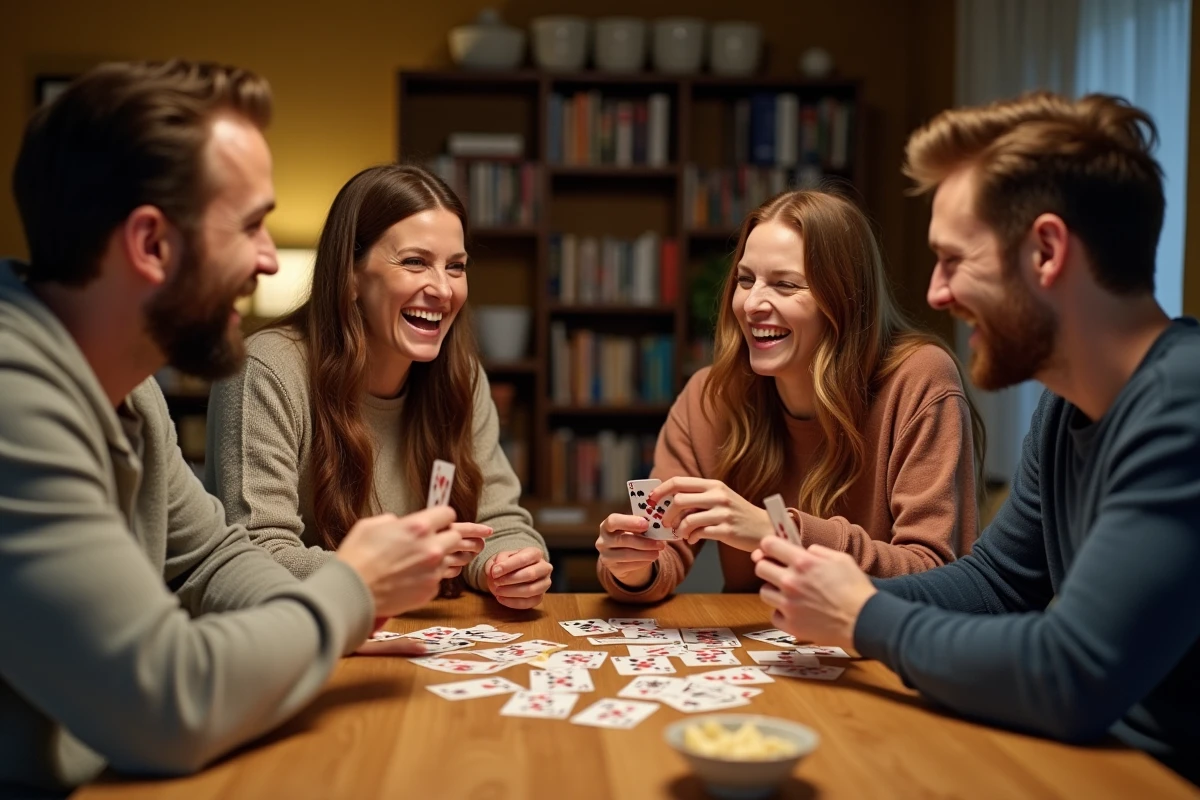
The game 7 14 21 is based on a simple mechanism: counting the aces rolled on the dice to reach specific thresholds. Most guides focus on the basic rules or alcoholic variants. However, analyzing the results of the game reveals that the difference between regular and occasional players lies less in chance than in reading the collective rhythm and choosing the right moment to roll the dice again.
Group Psychology vs. Pure Probabilities in 7 14 21
7 14 21 differs from a game like blackjack in one structural aspect. In blackjack, card counting provides a measurable advantage because the deck depletes and probabilities change. In 7 14 21, each roll of five dice resets the counters: the probability of rolling an ace remains the same each turn.
This observation changes the nature of useful strategies. Observing opponents weighs more than calculation. According to a comparative analysis published on BoardGameGeek, observation strategies prove significantly more effective than probability-based approaches in the context of 7 14 21.
| Criterion | Blackjack (card counting) | 7 14 21 (group observation) |
|---|---|---|
| Type of advantage | Mathematical, cumulative | Psychological, situational |
| Useful memory | Remaining cards in the deck | Players’ behavior at thresholds |
| Reset between rounds | No (the deck depletes) | Yes (the dice have no memory) |
| Main lever | Adjusting the bet according to the count | Anticipating reactions at threshold 14 |
This table illustrates why replicating a “counting” approach in 7 14 21 yields no gain. To explore other concrete avenues, you can win at the game 7 14 21 with Ouaps by consulting their detailed guide.

Adapting the game 7 14 21 for inclusive play with children aged 8 to 12
The majority of online resources present 7 14 21 as an adult party game, often associated with alcohol consumption. Adapting it for a family audience requires modifying three parameters without altering the core mechanism.
Replacing alcoholic penalties with a points system
The player who reaches threshold 7 earns one point, the one who reaches 14 earns two, and the one who reaches 21 designates a consequence for an opponent. The points system replaces alcohol without removing the tension of the game. The consequences can be short physical challenges (ten jumps, imitating an animal) or age-appropriate general knowledge questions.
Removing aggressive bluffing in favor of reflection pauses
Players report a noticeable decrease in verbal aggression during games thanks to the introduction of homemade “reflection pauses.” The principle: before each decisive roll (approaching thresholds 14 or 21), the player has ten seconds to observe the group and decide whether to roll again or pass.
This pause reduces frustrations related to failed bluffs, which is particularly useful with children aged 8 to 12 who manage social pressure less well. It also transforms the game into an observation exercise, enhancing its educational aspect.
- Threshold 7: the player who reaches it chooses a simple challenge for the next player (mime, riddle, light sports penalty)
- Threshold 14: the player earns the right to “protect” an ally for the next round, creating temporary alliances
- Threshold 21: the player designates a collective consequence (everyone does ten squats, for example)
This breakdown maintains the tension inherent in 7 14 21 while removing individual humiliation mechanics.
Tactical Strategies in 7 14 21: the Three Key Levers
Effective strategies in 7 14 21 focus on three axes. Detailing them helps understand why some players always seem better positioned at the thresholds.
The tempo of rolling
A player who consistently rolls quickly imposes a rhythm that others must endure. Deliberately slowing down one’s roll creates measurable psychological pressure: opponents interpret the hesitation as a signal, which alters their own decisions.
Reading reactions at threshold 14
Threshold 14 concentrates tension because it precedes the decisive zone. Observing who speeds up and who slows down at that moment provides information about each player’s level of confidence. Experienced players adjust their strategy between threshold 14 and threshold 21, not before.
The choice of when to pass
Passing one’s turn at the right moment is one of the underestimated tactical moves. A player who passes just before the critical threshold forces the next player to take the risk. This lever works best in groups of four players or more, where the pressure is unevenly distributed.

Regulation of Alcoholic Variants of 7 14 21 in Associative Contexts
A circular from the Ministry of the Interior dated January 2026 regulates the variants of 7 14 21 involving alcoholic beverages during associative parties. Organizers must display reminders about consumption limits to avoid sanctions.
This regulatory constraint, published in the Official Bulletin of Associations (n°2026-05, February 2026), directly concerns student associations and game clubs that schedule evenings around this type of game. In practice, this means that a responsible person must be designated to monitor consumption during the game.
- Mandatory display of consumption limits near the game table
- Designation of a sobriety referent among the organizers
- Prohibition of variants where the loser must drink cumulatively without limit
This regulation enhances the appeal of non-alcoholic variants, including for adult evenings. The points system or physical challenges described above offers a compliant alternative without diminishing the interest of the game.
7 14 21 remains a game whose mechanics can be summed up in one sentence, but whose tactical depth entirely depends on the group playing. Adapting the thresholds, observing reactions at the critical moment, and choosing when to pass are the three axes that separate a game endured from a game mastered.