
You open the fridge and find a pack of bacon bits bought the previous week, and the date printed on the packaging shows yesterday. The question arises every time: do we cook or throw it away? Checking the freshness of the bacon bits is not just about reading a date. Several concrete signals can help you decide even before turning on the pan.
Refrigerator Temperature and Bacon Bits: The Factor That Packaging Doesn’t Control
The date printed on the package is based on an assumption: a cold chain maintained between 0 and 4 °C. However, field studies show that the actual temperature of domestic refrigerators often exceeds this threshold.
A fridge set a bit too high, a door opened several times an hour while preparing meals, groceries left in the trunk for twenty minutes in summer: each break shortens the actual shelf life of the product. The expiration date loses its reliability if the cold has not been constant.
To establish a reliable basis, you can place a thermometer in the coldest part of the refrigerator (often the bottom shelf, above the vegetable drawer). If the temperature regularly exceeds 4 °C, you should consider that the safety margin built into the expiration date has already been consumed, even if the date has not yet been reached.
Knowing the expiration date of bacon bits and storage remains a solid starting point, but the actual storage temperature weighs as much as the date itself in the balance.
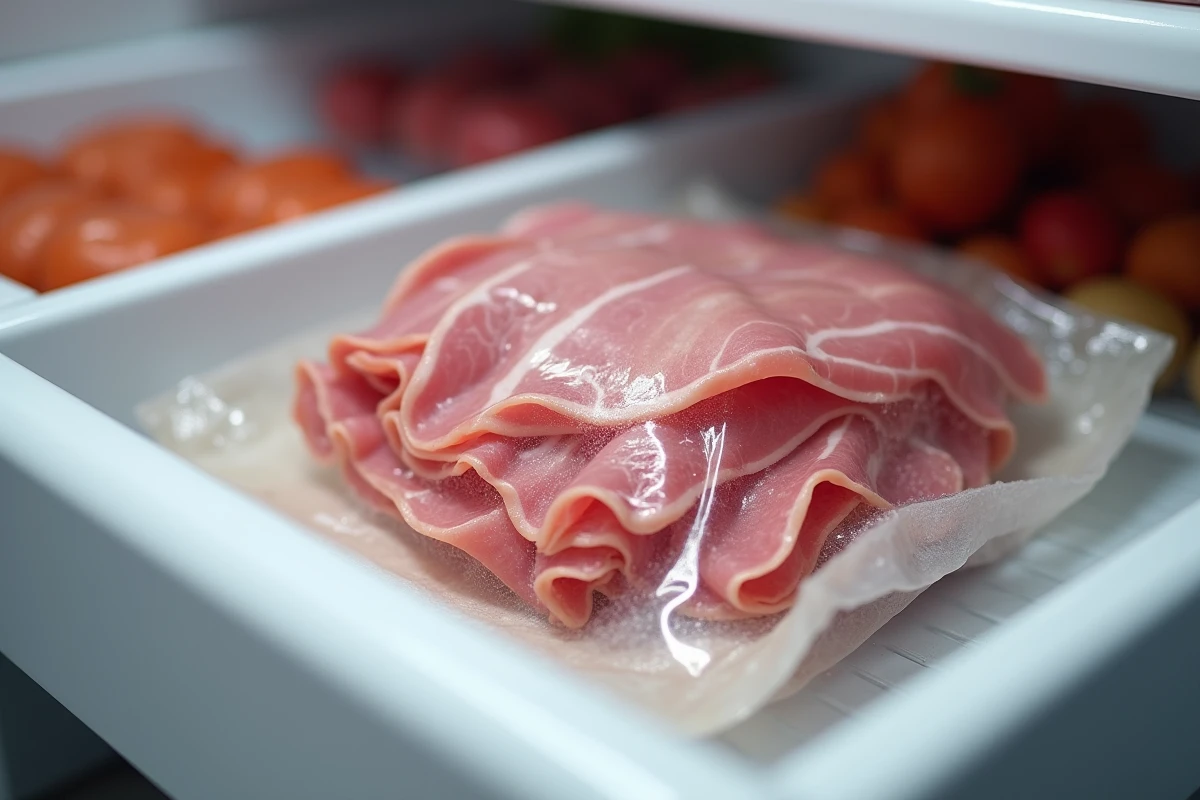
Expiration Date of Smoked or Regular Bacon Bits: Why the Duration Varies by Process
Not all bacon bits have the same shelf life, and the difference is not random. Smoking, packaging under modified atmosphere, and more recently, high-pressure processing (HPP) directly influence the expiration date printed on the package.
Expiration Date and Regulatory Safety Margin
The expiration date of refrigerated charcuterie is calculated based on growth studies of Listeria monocytogenes. The manufacturer incorporates a safety margin, but this varies from product to product. Smoked bacon bits packaged under modified atmosphere generally have a longer expiration date than regular bacon bits sold in simple trays.
HPP Treatment: An Extension of Expiration Date That Changes Nothing After Opening
Some manufacturers have been using high-pressure treatment for a few years to extend shelf life. The technique inactivates some bacteria without cooking. Once the package is opened, the rule remains the same: consume within 48 hours. HPP protects the sealed product, not the opened product.
In summary, two packs of bacon bits bought on the same day can have expiration dates that differ by several days. Reading the manufacturing process on the label (smoked, high-pressure treated, protective atmosphere) helps to understand why.
Concrete Signs of Bacon Bit Deterioration: Smell, Texture, Color
The date and temperature set the framework. But at the moment of decision, it is the senses that determine the outcome. We look for three signals, in this order:
- Smell: fresh bacon bits have a slightly salty and meaty smell. Any sour, acidic, or distinctly unpleasant note indicates advanced bacterial proliferation. If the smell is off-putting, the question is settled.
- Texture: a slimy or sticky film on the surface of the bacon bits indicates degradation. Fresh bacon bits remain slightly moist but without a slimy film to the touch.
- Color: a shift towards gray or green, even localized, is a stop signal. Pink or slightly brown bacon bits, depending on the smoking process, are normal.
Any one of these three criteria is enough to discard the product. And a point on which opinions vary: the absence of smell does not guarantee the absence of contamination. Some pathogenic bacteria, including Listeria, can develop without noticeably altering the smell or appearance of the product. Therefore, vigilance regarding the cold chain upstream remains the most reliable safety net.

Cooking Expired Bacon Bits: What the Pan Eliminates and What It Lets Through
It is often said that good cooking can “rescue” a questionable product. Heat does indeed destroy the majority of living bacteria if the internal temperature is sufficient for several minutes, but it does not neutralize everything.
Toxins produced by certain bacteria are heat-resistant. If staphylococci have had time to multiply in the package, their toxins will remain active even after being cooked in a hot pan.
Cooking does not replace prior verification. It adds a layer of safety to a product whose appearance, smell, and texture are normal. On a product that is already altered, it gives a false impression of control.
Storage of Bacon Bits After Opening: Important Steps
The package is open, and only half has been used. Here are the practical reflexes to limit risks on the remaining portion:
- Transfer the bacon bits to an airtight container or a well-sealed freezer bag, squeezing out as much air as possible.
- Place the container in the coldest part of the refrigerator, not in the door.
- Consume within 48 hours after opening, regardless of the expiration date printed on the original packaging.
- If quick consumption is not planned, freeze the remaining bacon bits immediately. They will then keep for several weeks in the freezer without significant degradation.
Freezing stops bacterial proliferation but does not destroy the bacteria already present. At the time of defrosting, you start with the same level of contamination as before freezing. Defrost in the refrigerator (never at room temperature) and cook on the same day.
Food waste related to bacon bits thrown away due to excessive caution exists, but the health risk of listeriosis or staphylococcal poisoning cannot be measured against the price of the package. When doubt persists after visual, olfactory, and thermal checks, the trash remains the most reasonable answer.