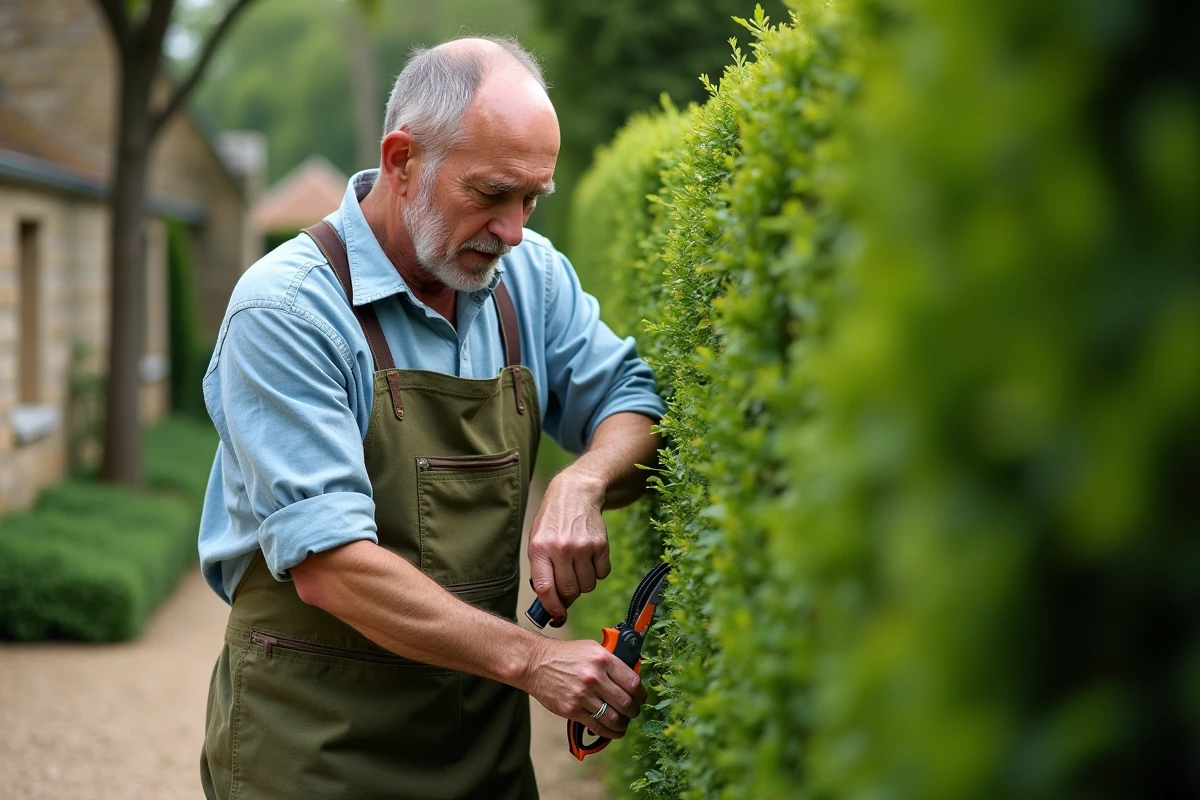
A hornbeam hedge planted three years ago that is going in all directions, laurel shoots spilling onto the sidewalk, a once-round boxwood now shapeless after a harsh winter. Properly trimming a hedge is not just about running the hedge trimmer in a straight line: it involves a series of technical choices that depend on the species, the season, and the desired shape.
Trapezoidal profile: the cut that changes the density of the hedge
Most hedges trimmed into a strict rectangle end up becoming bare at the base. The reason is simple: the branches at the top, more exposed to light, take over and shade the lower shoots. In a few seasons, you end up with a dense green wall at the top and transparent at the bottom.
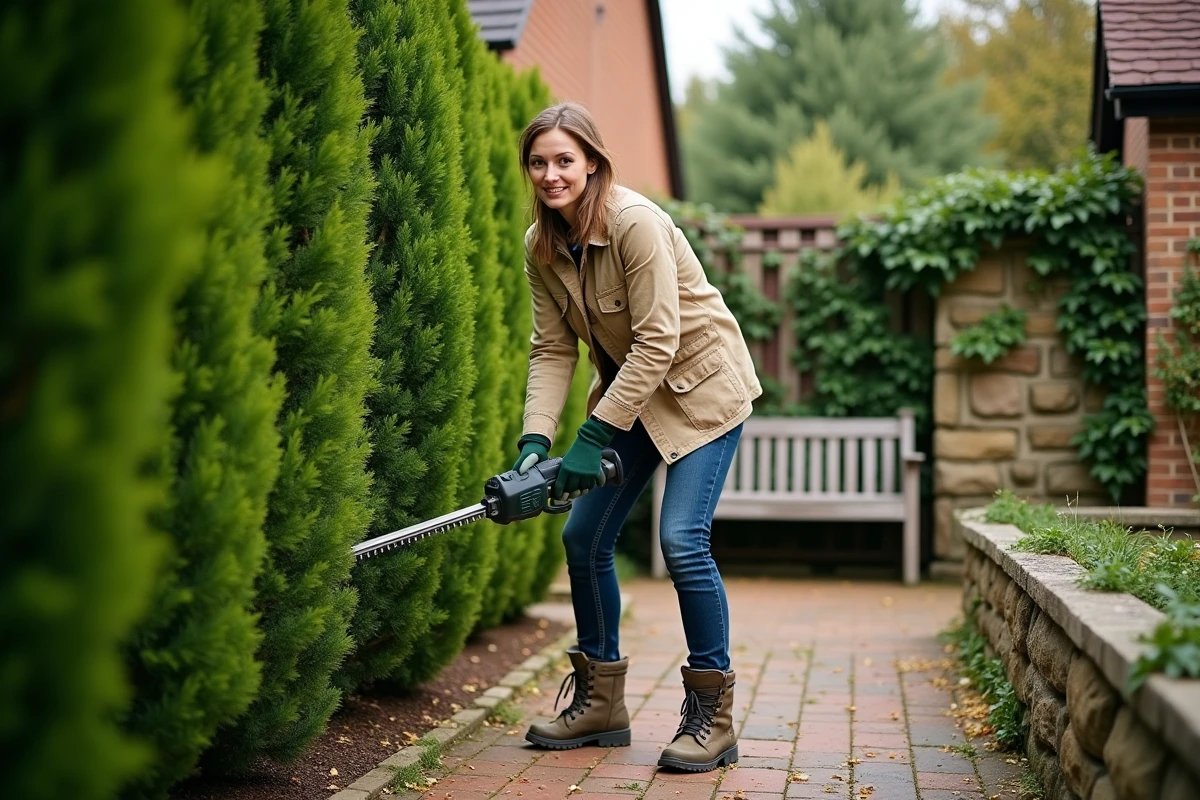
The solution that landscapers systematically apply is to trim the hedge slightly wider at the base than at the top. This trapezoidal profile (or slightly “A” shape) ensures that light reaches all layers of the foliage. On a boxwood or yew, the difference in width between the base and the top can remain subtle; a few centimeters are enough. On a hedge of thuja or laurel, the slope is accentuated more to compensate for the vigor of the top shoots.
To check the verticality, two stakes are planted and connected by a taut line at the desired height. Then, work section by section, keeping the hedge trimmer angled inward. Several guides available on sculpte-haie.com detail this technique according to the species.
Boxwood trimming and topiary: shaping without stressing the plant
Boxwood remains the reference in topiary art, but it is also found in low structural hedges in French gardens. Its slow growth allows for maintaining geometric shapes (ball, cone, spiral) with only two to three passes per year.
When to intervene on boxwood
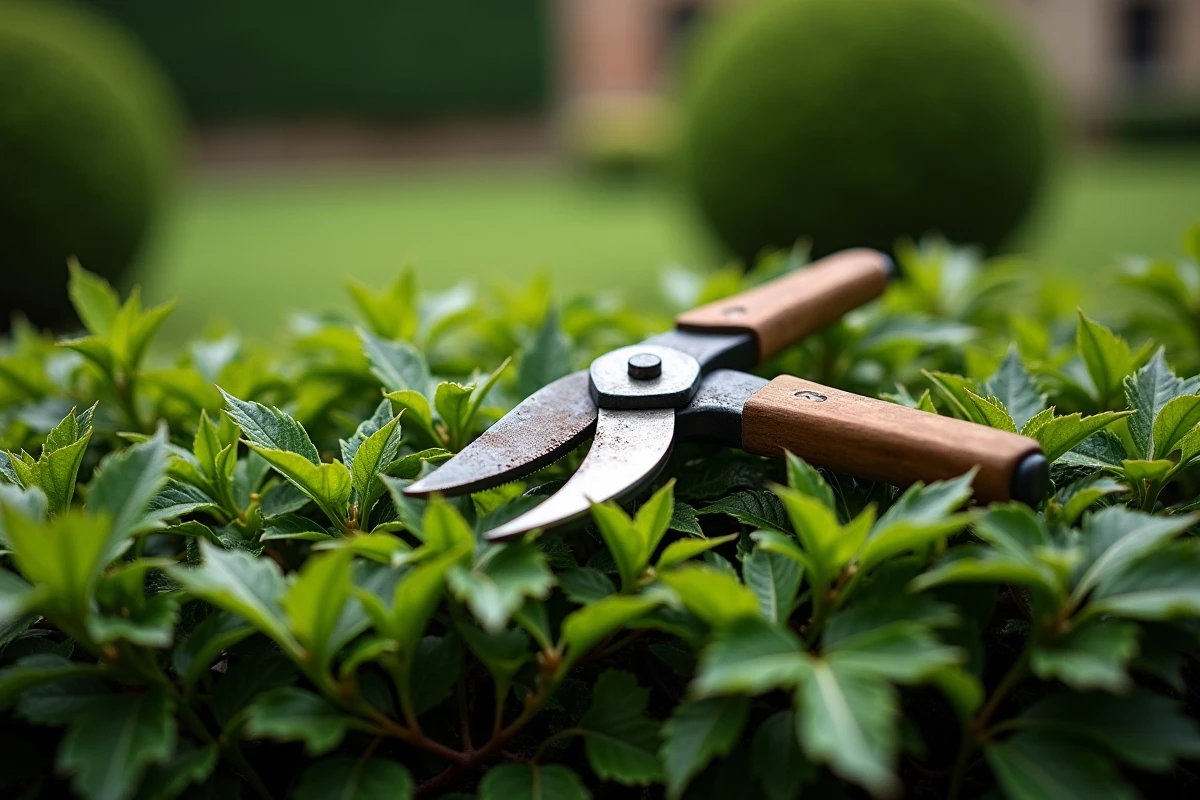
The first trimming is done after the spring growth, usually in June. Remove the young shoots that exceed the template without touching the old wood. A second light trimming in September refines the silhouette before winter. On a topiary shape in a ball, work with manual shears rather than an electric hedge trimmer: the precision of the gesture avoids the jolts that create visible holes for months.
Managing boxwood moth damage
If the boxwood moth has struck, you will notice defoliated areas where the wood appears bare. Trimming in these areas will not restart the vegetation as long as the caterpillar is active. First, treat (Bacillus thuringiensis), then wait for regrowth before trimming again.
Opinions vary on this point: some gardeners prefer to trim immediately to clean up, while others wait for a complete regrowth cycle.
Hedge trimming calendar and nesting constraints
Competitors often talk about “two trims per year, spring and fall.” In practice, the calendar primarily depends on the species and local regulations.
- Evergreen hedges (laurel, photinia, eleagnus) can handle a hard trim after the first spring growth and a maintenance trim at the end of summer or early fall.
- Deciduous hedges (hornbeam, beech, field maple) are preferably trimmed in winter when there is no frost, when the structure of the branches is visible and the sap has descended.
- Flowering hedges (forsythia, deutzia, spiraea) are trimmed just after flowering to avoid removing next year’s buds.
- Roses used in free hedges require specific trimming: shorten the spent stems by one-third and remove dead wood, usually at the end of winter.
From a regulatory standpoint, the period from mid-March to the end of July corresponds to nesting and any trimming that destroys an occupied nest is subject to penalties under Article L411-1 of the Environmental Code. Some municipalities and departments have enacted local orders that reinforce this prohibition. Before taking out the hedge trimmer in May or June, check that no birds are nesting in the hedge.
Free hedge or strict hedge: adapting the trimming to the garden’s goal
For several years, there has been a structural movement in favor of mixed and free hedges, encouraged by local authorities and naturalist associations. Some municipal operations even distribute plants of local species to replace monoculture hedges of thuja or cherry laurel.
A free hedge composed of several local species requires less trimming than a geometric hedge. An annual pass is sufficient to balance the volumes and remove dead wood. Maintenance is quicker, biodiversity is significantly higher (pollinator insects, nesting birds, small mammals), and the visual result is more natural.
In contrast, a strict hedge of yew or boxwood provides architectural structure to the garden. It requires more passes, precise tools (shears for finishing, hedge trimmer for long lengths), and strict adherence to the template. The choice between a free hedge and a strict hedge conditions the entire maintenance plan.
Arbitrating based on available space
A free hedge takes up more width than a hedge trimmed to a line. On a narrow property boundary, the strict hedge often remains the only viable option. In the back of the garden or along agricultural land, the country hedge integrates better and requires fewer interventions over the years.
Maintaining a well-thought-out hedge takes no more than a few hours a year if the right calendar and cutting technique are respected. The trapezoidal profile, respect for nesting periods, and the choice between free or strict shape are the three decisions that determine both the aesthetics and the long-term health of the hedge.