
An unusual bump is spotted at the edge of the anus while showering or after a difficult bowel movement, and the first reflex is to search for a photo online to compare. A significant portion of the images labeled “external hemorrhoid” online actually show something else: hypertrophied anal papillae, condylomas, mucosal prolapse, and sometimes even tumor lesions.
Comparing one’s lesion to the wrong reference delays treatment, and in some documented cases in city proctology, this delay concerns serious pathologies. This article outlines reliable visual and tactile markers for an external hemorrhoid, and especially the limits of self-diagnosis by photo.
External hemorrhoidal thrombosis: the 48 to 72-hour window that photos do not show
When we talk about a painful external hemorrhoid that has appeared suddenly, we often unknowingly refer to an external hemorrhoidal thrombosis. The distinction matters because the treatment strategy changes radically depending on the diagnosis.
A thrombosis manifests as a hard, tense, bluish or purplish lump, very painful to the touch. It appears within a few hours, often after straining, an episode of constipation, or a long journey in a seated position. It is not a simple venous congestion.
Several gastroenterologists emphasize a point that is rarely mentioned in mainstream content: this thrombosis sometimes benefits from a small excision surgery if treated within 48 to 72 hours. After this period, the clot begins to dissolve on its own, and the intervention loses its relevance. In a photo, it is impossible to date the appearance of the lesion or assess its tension. This is precisely where self-diagnosis reaches its limit.
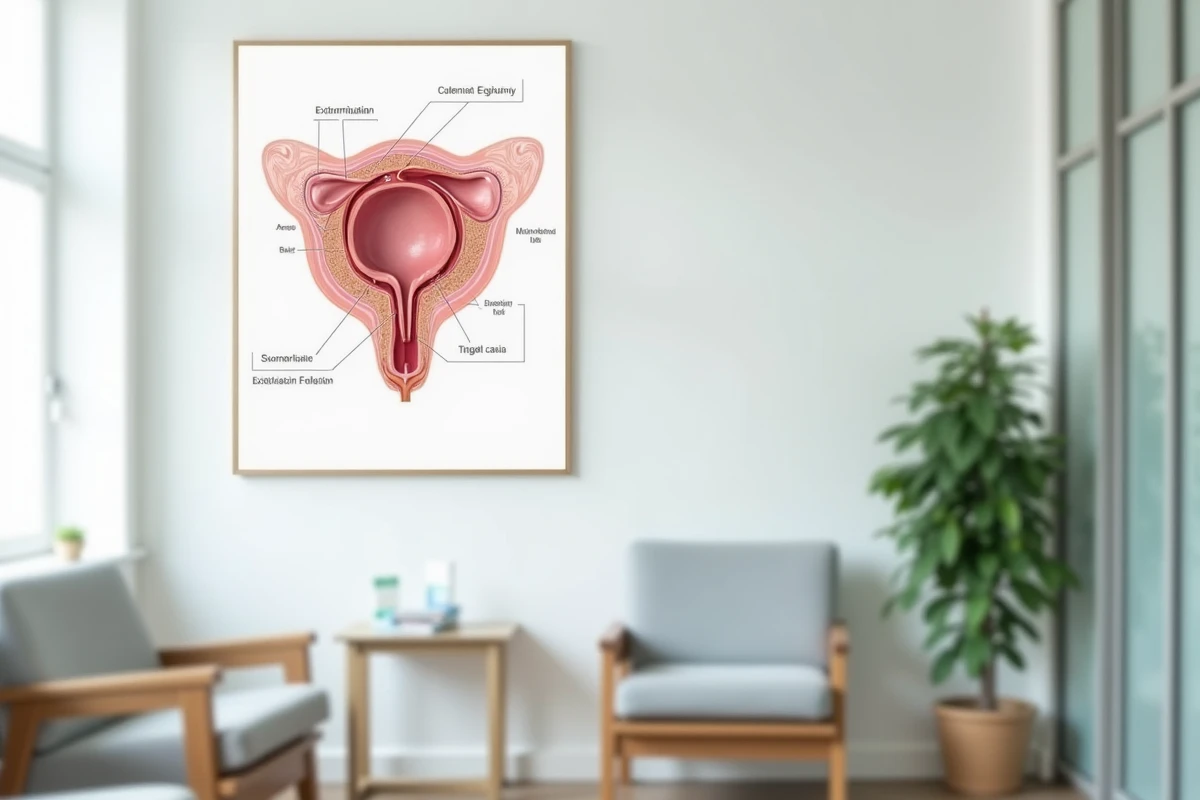
To deepen the visual reading of an anal lesion and better understand each photo of an external hemorrhoid and its causes, an illustrated support with medical captions remains more reliable than an image bank without context.
External hemorrhoid in photo: the true visual markers to know
In a reliable photo, a non-thrombosed external hemorrhoid appears as a soft swelling, skin-colored or slightly pink, located at the edge of the anal margin. It is covered with skin (not mucosa), which distinguishes it from an externalized internal prolapse, which is covered with moist, red mucosa.
What we observe visually
- One or more small soft bumps to the touch, sometimes grouped around the anal margin, close in color to the surrounding skin
- In the case of thrombosis, the lump becomes firm, tense, with a bluish or purplish hue visible even in photos
- No spontaneous bleeding in the majority of cases (unlike internal hemorrhoids that bleed during bowel movements)
- Residual skin folds, called tags, may persist after the crisis and be confused with an active hemorrhoid
The most common trap: confusing a tag (a painless sequel from an old episode) with an ongoing crisis. A tag requires no treatment. It is soft, the color of the skin, and does not cause pain or recent swelling.
What a photo cannot evaluate
The consistency to the touch, pain on palpation, and especially the possible presence of an associated internal lesion. A doctor performs a rectal examination and sometimes an anoscopy to complete the assessment. Visual inspection alone does not replace a complete clinical examination.
Frequent confusion with other anal lesions: condylomas, fissures, abscesses
Feedback from city proctologists and teleconsultations confirms a recurring pattern: many patients who consult by showing a photo think they have an external hemorrhoid when the lesion is of another nature.
A condyloma (genital wart related to the papillomavirus) can present as a small growth at the anal margin. The difference: the condyloma has an irregular, “cauliflower” surface and is generally not painful. In photos, the confusion is easy, especially when the resolution is low.
An anal fissure causes sharp pain during and after a bowel movement, sometimes with bright red bleeding. It is not always visible in photos because it is located in the fold of the anal canal. It can coexist with a sentinel tag, further blurring the visual diagnosis.
An anal abscess is distinguished by diffuse redness, local warmth, and pulsating pain. It is a surgical emergency that should not be treated as a hemorrhoid. The documented delay in diagnosis in these cases often involves a phase of self-medication at home.

Real causes behind an external hemorrhoid: transit above all
We often focus on the visible lesion, but practitioners remind us that the majority of patients with an external hemorrhoid suffer from an underlying transit disorder. Chronic constipation, functional diarrhea, irritable bowel syndrome: the hemorrhoidal crisis is frequently a secondary symptom.
The increase in pressure in the veins of the anorectal region causes the dilation of the hemorrhoidal plexuses. This pressure can result from repeated straining during defecation, frequent heavy lifting, or pregnancy. Prolonged sitting worsens the phenomenon by slowing venous return.
What worsens the situation without us realizing it
Social media spreads “home remedies” (baking soda, apple cider vinegar, ice applied directly) for hemorrhoids. None of these treatments have validated evidence of effectiveness. Worse, applying ice directly to the mucosa or anal margin can worsen irritation and cause additional skin lesions.
Validated local treatments remain venotonic topicals, warm sitz baths, and regulating transit through adequate fiber and water intake. Any episode that does not improve within a few days, or that is accompanied by fever, heavy bleeding, or unbearable pain, requires in-person medical advice.
Recognizing an external hemorrhoid in a photo remains a useful first filter, provided one keeps its blind spots in mind. Color, location, and texture provide clues, but neither the severity nor the exact nature of a lesion can be confirmed on screen. A clinical examination with a rectal touch clarifies in a few minutes what an hour of image searching cannot resolve.